Resident stories
Natural Disasters and Renting: What Your Contract Says About Earthquakes and Typhoons
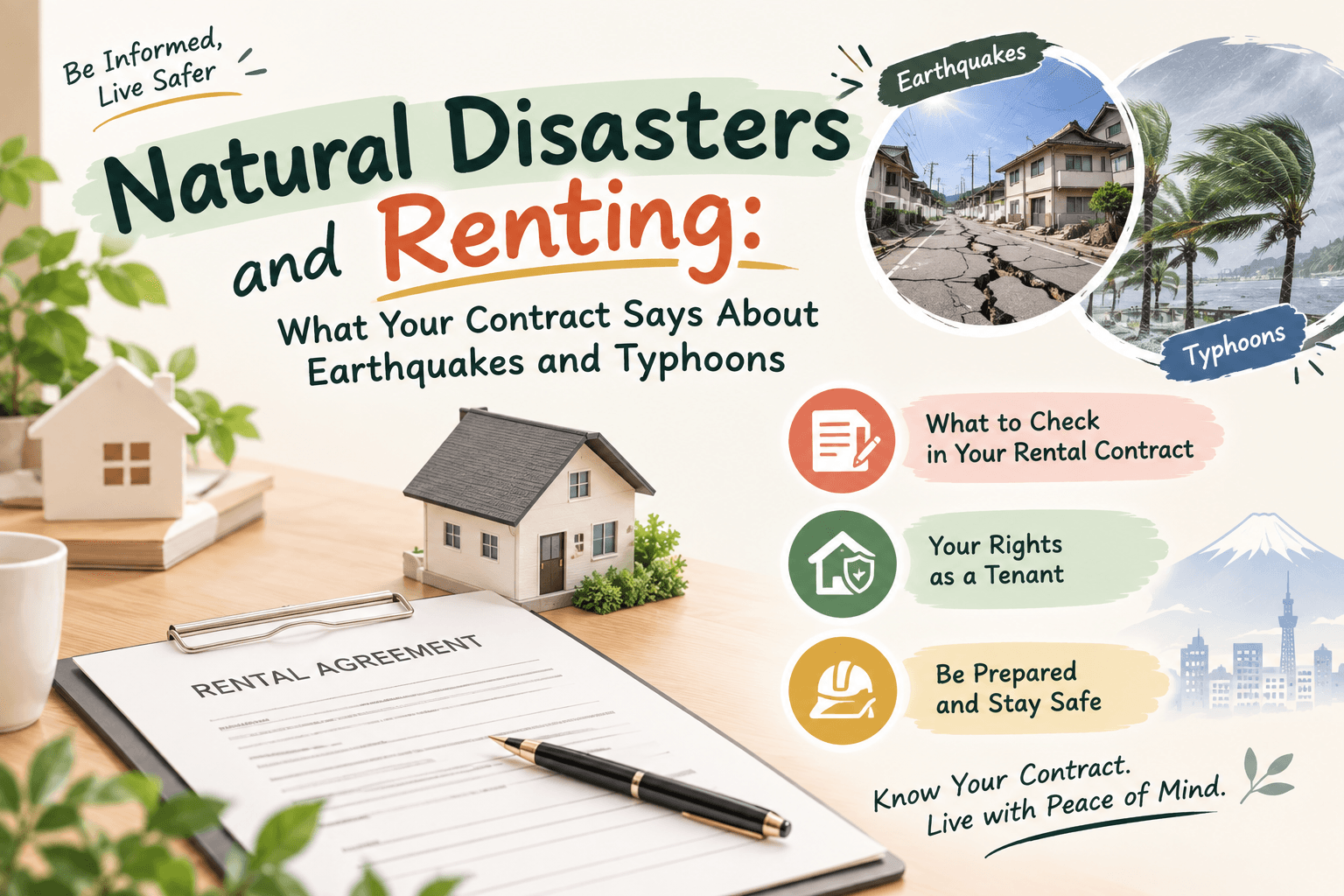
Japan's earthquakes, typhoons, and occasional flooding aren't just something to prepare for personally — they also show up in your rental contract, your insurance, and your landlord's responsibilities. Here's what to actually understand before signing a lease.
Earthquake Resistance: Check the Building's Construction Date
Japan's building codes changed significantly after major earthquakes, and your building's construction date matters more than people realize.
新耐震基準 (New Earthquake Resistance Standard) has applied to buildings built from June 1981 onward. These buildings were designed to withstand stronger earthquakes without collapsing, even if damaged.
旧耐震基準 (Old standard) buildings — built before June 1981 — may not meet current safety expectations. This doesn't automatically mean a building is unsafe, but it's worth asking directly about any reinforcement work done since.
Tip: It's completely reasonable to ask your agent directly: "この建物は新耐震基準ですか?" (Is this building built to the new earthquake resistance standard?) Most listings also state the construction year, which tells you this immediately.
Fire and Earthquake Insurance (火災保険・地震保険)
Almost every rental contract in Japan requires tenants to purchase fire insurance (火災保険) as a condition of the lease — this is standard, not optional, and is usually arranged through the agency at move-in for a 1–2-year term.
Earthquake insurance (地震保険) is typically a separate add-on, not automatically included with fire insurance. It's worth asking specifically whether your policy includes earthquake coverage, since standard fire insurance generally does not cover earthquake-related damage on its own.
What Your Contract Says About Disaster Damage
Most standard lease contracts include language about unavoidable events (不可抗力) — circumstances like major natural disasters that are outside anyone's control. In general:
・If a disaster makes the unit completely uninhabitable, the lease may be considered automatically terminated, and you typically aren't held responsible for remaining rent.
・If damage is partial, the situation is murkier — responsibilities can depend on the specific contract terms, the extent of damage, and negotiation with the landlord.
・Your deposit (敷金) isn't meant to cover disaster-related damage — that's a separate matter from your insurance and the landlord's own building insurance.
Because this varies so much by contract, it's worth actually reading the relevant clause (often listed under 天災 or 不可抗力) rather than assuming.
What Your Landlord Is (and Isn't) Responsible For
・Landlords are generally responsible for maintaining the building's basic structural safety and for repairs to building-level damage after a disaster.
・Tenants are generally responsible for their own personal belongings — this is exactly what fire/earthquake insurance is meant to cover, since the landlord's building insurance typically doesn't extend to your furniture, electronics, or other possessions.
Flooding and Typhoons: Check the Hazard Map First
Before signing a lease, it's worth checking your city's ハザードマップ (hazard map) — most municipalities publish these online, showing flood risk, landslide risk, and designated evacuation sites for your specific address. This is especially relevant for ground-floor units and properties near rivers.
Ask your agent whether the building has experienced flooding in recent years, and check whether the unit is above typical flood-risk levels for the area.
Practical Steps Before and After Signing
⓵Check the construction year for earthquake standard compliance.
⓶Confirm what your required insurance actually covers — ask specifically about earthquake coverage.
⓷Check your city's hazard map for flood and landslide risk at the specific address.
⓸Locate your nearest evacuation site (避難所) once you move in — this is usually posted at the building or available through the city hall.
⓹Keep a basic emergency kit regardless of the building's safety rating — water, a flashlight, and essential documents at minimum.
The Bottom Line
Your rental contract already addresses what happens in a major disaster, even if you've never read that section closely. Check your building's earthquake standard, confirm what your insurance actually covers, and look up the hazard map for your address before signing — not after a typhoon warning is already on the news.