入居者の声
Family Housing: What Changes When You're Renting With Kids
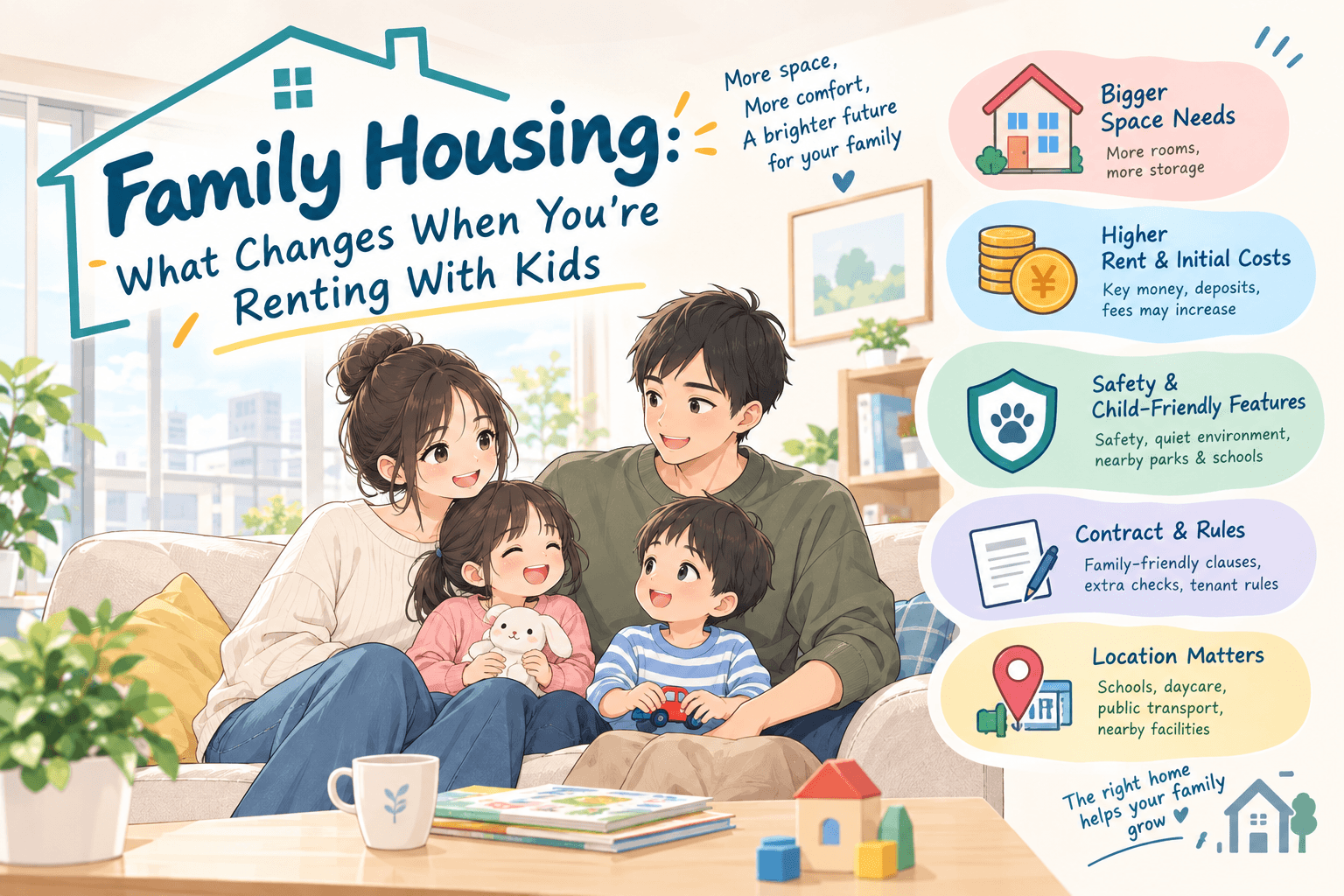
Renting as a family in Japan isn't just a bigger version of renting alone. Floor plans, contracts, noise rules, school areas, and city hall paperwork all work differently once children are involved. Here's what to think about before you start searching.
Choose the Right Size and Floor Plan
Japanese floor plans are labeled by number of rooms plus living/dining/kitchen space (for example, 2LDK or 3LDK). For families, a few rules of thumb help:
➊A couple with one young child can often manage in a 2LDK.
➋Two or more children usually need a 3LDK or larger as they grow.
➌Look for "ファミリー向け" (family-oriented) listings. These are designed with families in mind and tend to be more welcoming to tenants with children.
Remember that bigger floor plans cost much more in central Tokyo, so many families trade a longer commute for more space.
Tell the Agent and Landlord About Your Whole Family
Rental contracts in Japan usually list exactly who will be living in the unit. This matters for a few reasons:
① Everyone living there should be named on the application. Adding a family member later, including a newborn, may ② require notifying your landlord or management company.
③ Landlords sometimes ask about family size because it affects wear and noise in the building.
④ Be upfront from the start. Hiding the number of occupants can create serious problems later.
Noise: Plan for It Before It Becomes a Problem
Children make noise, and Japanese apartments often have thin walls and floors. This is one of the most common sources of tension for families.
➊Ground-floor units are often a good choice, since footsteps won't disturb a downstairs neighbor.
➋Ask about the building's construction. Some buildings have better soundproofing than others.
➌Use rugs or floor mats to dampen footstep noise, especially for young children who run and jump.
➍Introduce yourselves to neighbors with a short, polite greeting when you move in. It goes a long way if noise ever comes up.
Check the Neighborhood, Not Just the Apartment
For families, the area around the apartment matters as much as the unit itself. When comparing listings, look at:
➊Distance to supermarkets, parks, and pediatric clinics
➋Safety of the walking route to schools and nurseries
➌Elevators and stairs, especially if you use a stroller
➍Daycare (保育園) availability in the ward, since waiting lists can vary a lot by area
School District and Daycare
In Japan, public elementary and junior high schools are assigned by address, so where you rent decides which school your child attends. If a particular school matters to you, confirm the school district (学区) before signing a lease.
Daycare availability also differs by ward and city. If you'll need daycare soon, ask your city hall about current availability and application deadlines as early as possible, ideally before you choose where to live.
City Hall Procedures for Families
When you move, register your whole family at city hall. Several child-related benefits depend on this:
⓵ Child allowance (児童手当): Apply at your new city hall soon after moving. The deadline is short, roughly 15 days after your move, so don't wait.
⓶ Medical expense subsidies for children (子ども医療費助成): These vary by city, so check what your new municipality offers.
⓷ Child health checkups and vaccinations: Your city hall can explain the local schedule and how to book.
Money Considerations
➊Family-sized apartments cost more upfront, because deposit and key money are calculated from monthly rent.
➋Guarantor companies will look at household income relative to rent, so apply with accurate information about everyone's income.
➌Compare subsidies across cities. Some municipalities offer more generous support for families, which can offset higher rent.
The Bottom Line
Renting with kids means thinking beyond the apartment itself. Be upfront about your family size, choose a layout and floor that suit your children's noise level, check the neighborhood and school area, and register at city hall quickly to claim child-related benefits. A little preparation makes the move far smoother for the whole family.