Area guides
No Guarantor? No Problem: How Guarantor Companies (保証会社) Work in Japan
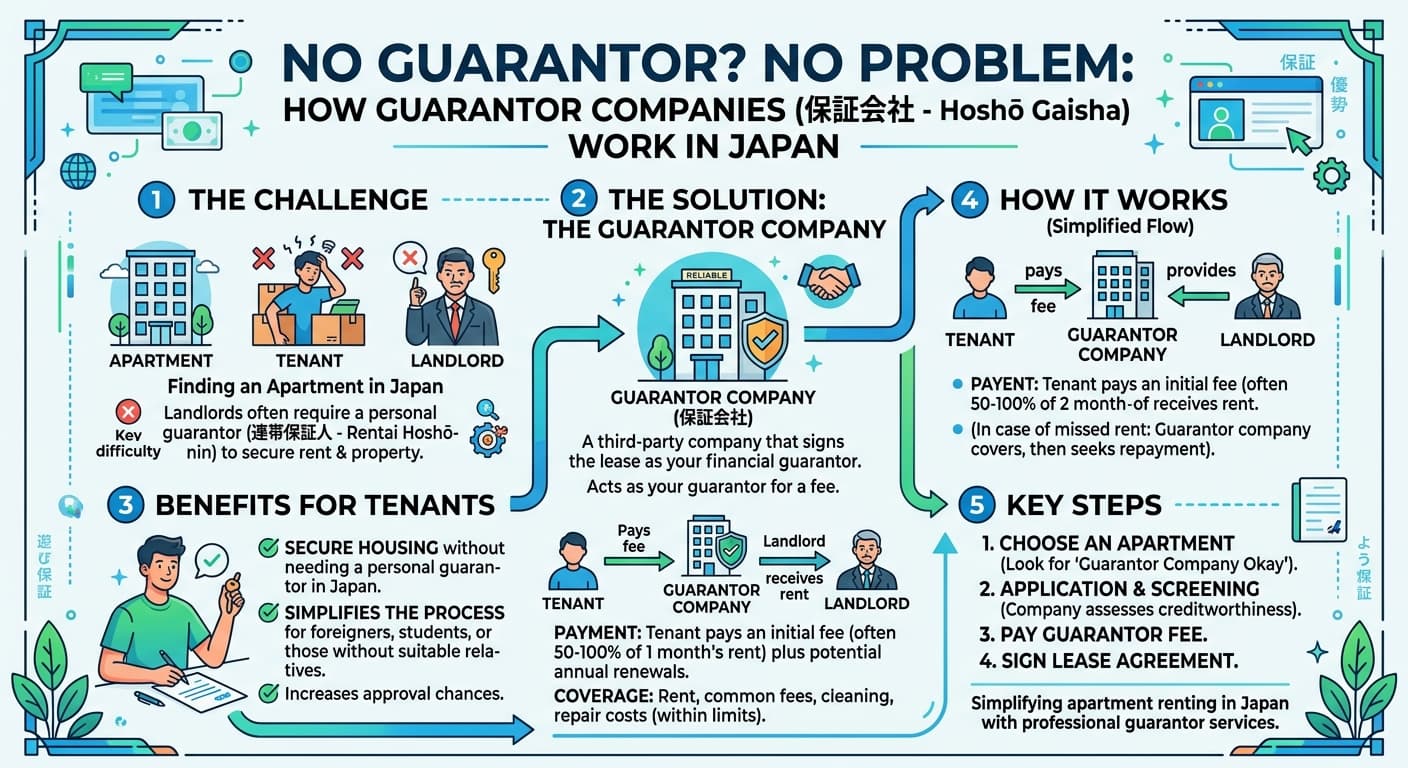
Almost every rental contract in Japan requires a guarantor (保証人) — someone who agrees to cover your rent if you can't pay. For most foreign renters without family in Japan, this used to be a major roadblock. Today, it isn't, thanks to guarantor companies (保証会社), which have become the standard solution for renters of all nationalities.
What a Guarantor Company Actually Does
A guarantor company acts as your financial guarantor in place of a person. Instead of asking a relative or close friend to take on legal responsibility for your rent, you pay a fee to a company that guarantees your rent to the landlord instead.
If you ever fail to pay rent, the guarantor company pays the landlord on your behalf — and then follows up with you directly to recover that amount. This protects the landlord's income while giving renters without a personal guarantor a way to qualify for an apartment.
Typical Costs
>> Initial fee: Usually around 50% of one month's rent, though this varies by company and property.
>> Renewal fee: Often an annual fee of ¥10,000–20,000, or occasionally a percentage of rent, to keep the guarantee active for each additional year.
These costs are separate from the landlord's own deposit (敷金) and key money (礼金), so it's worth budgeting for this as its own line item when calculating move-in costs.
Do You Get to Choose the Guarantor Company?
Usually not — the real estate agency or landlord will specify which guarantor company (or companies) they work with for a given property. Some agencies work with a wide range of companies, including ones well known for accepting foreign applicants; others may only work with one or two options that are stricter about visa type, income, or Japanese language ability.
This is exactly why it's worth asking early in your apartment search whether a listing's guarantor company accepts foreign applicants on your specific visa type, rather than finding out after you've already fallen for a place.
What Guarantor Companies Typically Check
>>Visa status and remaining period — a visa with very little time left can sometimes complicate approval
>>Income relative to rent — most companies want rent to be well within a reasonable proportion of your monthly income
>>Employment stability — full-time, ongoing employment is generally viewed more favorably than short-term contracts
What If You're Rejected?
If a guarantor company rejects your application, it doesn't necessarily mean you can't get the apartment — it may simply mean that specific company isn't a fit for your situation. Options include:
>>Asking the agency if the property works with any alternative guarantor companies
>>Providing additional documentation (a longer employment history, a letter from your employer or registered support organization confirming stability)
>>Looking at similar listings through an agency known for working with foreign-friendly guarantor companies
The Bottom Line
Not having a personal guarantor in Japan isn't the obstacle it used to be. Guarantor companies have effectively become the default across most of the rental market, foreign renters included. The key is asking upfront which guarantor company a listing uses, whether it works with your visa type, and budgeting for the initial and renewal fees as a normal part of your move-in costs — not an unexpected extra.